How to Shoot Precision Rifle With Professional Accuracy
Table of Contents
- Introduction
- The Foundation of Stability and Natural Point of Aim
- Mastering the Sight Picture and Optic Setup
- The Mechanics of the Shot
- Understanding Ballistics and Environmental Factors
- Essential Gear for the Precision Marksman
- Training and Practice Drills
- Advancing Your Skills
- Conclusion
- FAQ
Introduction
Standing on a range with a bolt-action rifle is one thing; consistently hitting a 10-inch steel plate at 800 yards is another. Precision rifle shooting is a discipline of millimeters where every tiny error is magnified by distance. Whether you are a veteran looking to sharpen your long-range skills or a tactical enthusiast entering the world of precision series (PRS) matches, the fundamentals remain the same. At Crate Club, we know that having the best gear is only half the battle. You need the technical proficiency to back it up. This guide covers the essential mechanics of stability, sight alignment, and environmental adjustments required to master the long-range shot. True precision comes from the marriage of high-quality equipment and disciplined, repeatable technique.
Quick Answer: Shooting a precision rifle requires mastering the five fundamentals: stable position, sight alignment, breath control, trigger press, and follow-through. Success depends on establishing a Natural Point of Aim (NPOA) and accurately accounting for external variables like wind and bullet drop.
The Foundation of Stability and Natural Point of Aim
Stability is the most critical element of a precision shot. If the rifle is moving, the bullet is moving. Before you even touch the trigger, you must build a position that allows the rifle to sit on the target without any muscular effort. This is known as the Natural Point of Aim (NPOA). If you have to "muscle" the rifle onto the target, your body will naturally relax at the moment of the shot, causing the muzzle to shift.
To find your NPOA, get into your shooting position and align your sights on the target. Close your eyes, take a deep breath, and let it out. When you open your eyes, the reticle should still be exactly where you want to hit. If it has shifted left or right, do not move the rifle with your arms. Instead, shift your entire body until the rifle naturally rests on the bullseye.
The Prone Position
The prone position—lying flat on your stomach—is the most stable platform for precision shooting. Your body should be directly behind the rifle, not at an angle. This allows your shoulder to absorb the recoil linearly. If you are angled, the rifle will jump to the side after the shot, making it impossible to see where your bullet landed (the "splash").
For additional perspective on core shooting fundamentals, review this precision rifle shooting guide.
Utilizing Support
Most precision shooters use a bipod and a rear bag. A bipod provides front-end stability, while a rear bag (a small sand-filled pouch placed under the buttstock) allows for micro-adjustments in elevation. By squeezing or releasing the rear bag with your non-dominant hand, you can move the reticle up or down with extreme precision.
A properly selected bipod can make a major difference in stability, so compare support options in the Crate Club Gear Shop.
Field Note: Never rest your rifle barrel directly on a hard surface like a rock or a barricade. This interferes with the barrel’s natural harmonics and will throw your shot wide. Always rest the handguard or the bipod on the support.
Mastering the Sight Picture and Optic Setup
Precision rifles usually wear high-magnification scopes. However, a high-end optic is useless if it is not set up correctly for your eye. Two factors are paramount: eye relief and parallax.
Eye Relief and Cheek Weld
Eye relief is the distance between your eye and the rear lens of the scope. You should have a full, clear image without any black shadows around the edges (shadowing). This is achieved through a consistent cheek weld. Your head should rest naturally on the stock’s comb (the top part of the buttstock) with enough pressure to keep it steady but not so much that it causes strain.
For a broader look at magnification and aiming systems, read about how a rifle scope works.
Understanding Parallax
Parallax is an optical illusion where the reticle appears to move against the target when you move your head. Most precision scopes have a parallax adjustment knob, often located on the left side of the turret housing. To fix this, look through the scope and move your head slightly. If the reticle shifts, adjust the parallax knob until the reticle stays "glued" to the target.
MOA vs. MIL
You must understand your scope's adjustment system. Most modern operators prefer Mils (Milliradians), but MOA (Minute of Angle) is still common in the US.
- MOA: Roughly 1 inch at 100 yards. 1/4 MOA clicks move the point of impact 0.25 inches at 100 yards.
- Mil: Roughly 3.6 inches at 100 yards. 0.1 Mil clicks move the point of impact 0.36 inches at 100 yards.
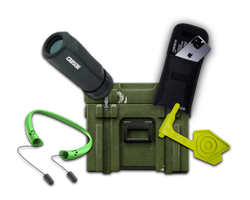
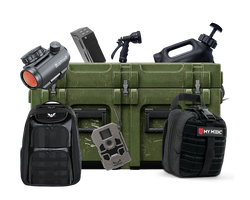
Whatever system you choose, stay consistent. Do not try to convert between the two in the field. Think in the units your scope uses. Our Major tier often features optics and tools designed to help you master these adjustments without the guesswork. You can see what's inside the Major tier before choosing your subscription level.
The Mechanics of the Shot
Once you have a stable position and a clear sight picture, the shot itself comes down to four distinct phases: breathing, trigger control, the break, and follow-through.
Breath Control
You cannot hold your breath indefinitely; doing so causes muscle tremors and vision blur. Instead, use your "natural respiratory pause." This is the brief moment after you exhale and before you inhale again when your body is at its most still. This window lasts about 2 to 4 seconds. That is your shot window.
Trigger Press
The trigger press must be a straight-back motion. Use the pad of your index finger, not the joint. The goal is to apply increasing pressure until the rifle fires as a "surprise." If you know exactly when the rifle will fire, you are more likely to flinch or "anticipate" the recoil, which pushes the muzzle down.
Follow-Through
Follow-through is the most neglected part of precision shooting. After the trigger breaks, continue to hold the trigger to the rear. Keep your eye behind the scope and watch for the impact. This ensures you aren't moving the rifle before the bullet has actually left the barrel. It also allows you to "call your shot," meaning you know exactly where the reticle was when the round went off.
Key Takeaway: Precision shooting is the art of removing variables. By establishing a Natural Point of Aim and maintaining a consistent follow-through, you eliminate the most common causes of missed shots.
Understanding Ballistics and Environmental Factors
At short distances, gravity and wind are negligible. At 500 yards and beyond, they are everything. You must account for bullet drop (elevation) and wind drift (windage).
Elevation and D.O.P.E.
Gravity is a constant. If you know the velocity of your bullet and the distance to the target, you can predict exactly how much it will drop. Serious shooters keep a logbook called a D.O.P.E. book (Data On Previous Engagements). This records how many Mils or MOA you needed to hit a target at specific distances and temperatures.
Cold air is denser than warm air, meaning bullets drop faster in the winter. High altitude (lower air pressure) means less drag, so the bullet flies flatter. Always record the environmental conditions when you are recording your data.
Reading the Wind
Wind is the "great equalizer" in precision shooting. Unlike gravity, wind is not constant. It can change direction or speed between your position and the target.
- Full Value Wind: A wind blowing directly from your left or right (9 o'clock or 3 o'clock). This has the maximum impact on the bullet.
- Half Value Wind: A wind blowing at a 45-degree angle. It has about half the impact of a full-value wind.
- No Value Wind: A wind blowing directly toward or away from you.
To read the wind, look for "mirage"—the heat waves shimmering off the ground. If the mirage is moving horizontally, the wind is strong. If it is boiling straight up, there is no crosswind. You can also watch for grass movement or flags to estimate speed.
Essential Gear for the Precision Marksman
While skill is primary, your gear must be capable of the task. A standard hunting rifle might be a 2 MOA gun, meaning it shoots 2-inch groups at 100 yards. For precision work, you want a rifle and ammo combination capable of "Sub-MOA" (groups smaller than 1 inch at 100 yards).
For a wider look at platform selection and rifle components, explore this guide to tactical rifle essentials.
The Rifle and Barrel
A heavy, "varmint" or tactical profile barrel is preferred. Thicker barrels heat up more slowly and are more rigid, which improves consistency. A free-floated barrel, where the stock does not touch the barrel at any point, is mandatory.
Match Grade Ammunition
You cannot expect precision from bulk surplus ammo. Match-grade ammunition uses more consistent powder charges and aerodynamic bullets with high Ballistic Coefficients (BC). High BC bullets resist wind drift better and retain their velocity longer.
Support Systems
A quality bipod with adjustable legs is essential for uneven terrain. We frequently feature heavy-duty support gear and EDC (Everyday Carry) tools in our Captain and Major tiers to ensure our members are prepared for the field. A rear bag is equally important. Many operators use a "sock" filled with plastic beads or specialized sand.
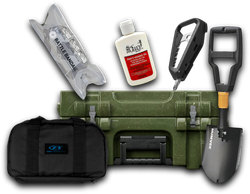
You can see what's inside the Captain crate to compare the mid-level gear selection.
For more on how support affects consistency, read how bipods affect accuracy.
Bottom line: Invest in a solid rifle and match ammo, but spend the rest of your budget on a high-quality optic and a lot of practice rounds.
Training and Practice Drills
You don't need a 1,000-yard range to get better. Many of the best precision shooters spend hours "dry firing"—practicing the trigger press and follow-through with an empty chamber.
Dry Fire Drill
Set up your rifle in a prone position in your home. Pick a tiny point on a wall (ensure the rifle is unloaded and no ammo is in the room). Practice finding your NPOA, breathing, and breaking the trigger without the reticle moving a hair's breadth. If the reticle jumps when the firing pin drops, you are jerking the trigger.
The "Cold Bore" Shot
In a real-world tactical or hunting scenario, you don't get a "warm-up" shot. The first shot from a cold, clean barrel often has a slightly different point of impact than subsequent shots. Every time you go to the range, the very first shot you fire is the most important. Record exactly where it hits. This is your "cold bore" data, and it is what you will rely on in a high-stakes situation.
Positional Shooting
Once you master prone, practice shooting from a seated position, kneeling, or using a tripod. In the field, you rarely get the luxury of a perfectly flat prone spot. Learning to use a barricade or a tree for support while maintaining your fundamentals is what separates a range shooter from an operator.
For additional stability techniques, continue with this guide to attaching a bipod to a rifle.
Advancing Your Skills
Precision shooting is a perishable skill. It requires a deep understanding of physics and a high level of self-awareness. You have to be honest with yourself about why you missed a shot. Was it the wind? Or did you pull the trigger too hard?
As you progress, you will start to learn about "spin drift" (the bullet drifting slightly in the direction of the rifling's twist) and the "Coriolis effect" (the rotation of the earth affecting very long shots). While these factors only matter at extreme ranges (usually 1,000+ yards), they are part of the journey toward total mastery of the platform.
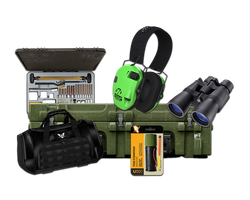
We provide the gear that helps you bridge the gap between amateur and professional. Whether it is a precision cleaning kit to maintain barrel accuracy or tactical optics to see what others miss, Crate Club is built by Spec Ops veterans who have relied on this equipment in the most demanding environments on earth. When you are ready to build a recurring loadout, choose your Crate Club subscription.
Conclusion
Mastering the precision rifle is a lifelong pursuit of consistency. It starts with a stable position and a clear understanding of your Natural Point of Aim. By refining your breathing and trigger control, you can ensure that the rifle stays on target through the break of the shot. Remember that the environment is always changing; your ability to read the wind and account for gravity is what determines your success at distance. Use high-quality gear, record your D.O.P.E. religiously, and never stop practicing the fundamentals.
- Establish a stable, bone-supported position.
- Align your body for a Natural Point of Aim.
- Eliminate parallax and maintain a consistent cheek weld.
- Master the surprise trigger break and follow-through.
- Keep detailed records of every shot and environmental condition.
If you are ready to upgrade your loadout with gear that is field-tested and veteran-approved, explore the Captain and Major tiers. Building a professional-grade kit takes time, and we are here to ensure you have the best tools for the job.
FAQ
What is the difference between MOA and Mil?
MOA (Minute of Angle) is an angular measurement roughly equal to 1 inch at 100 yards, while Mil (Milliradian) is an angular measurement roughly equal to 3.6 inches at 100 yards. Mils are the standard for most military and professional shooters because they work on a base-10 system, making math easier for some, while MOA is often preferred by those accustomed to imperial measurements.
How do I stop my rifle from "jumping" when I shoot?
Rifle jump is usually caused by poor body alignment. Ensure your body is directly behind the rifle in a straight line so the recoil travels straight through your shoulder into the ground. If your body is at an angle, the recoil will find the path of least resistance and push the rifle to the side.
Why is a rear bag so important for precision shooting?
A rear bag provides a third point of contact and allows for much more stable and precise elevation adjustments than using your muscles. By gently squeezing the bag, you can move the reticle up or down in tiny increments without introducing muscle fatigue or tremors into the system.
How often should I clean my precision rifle barrel?
This is a debated topic, but many precision shooters clean their barrels every 100 to 200 rounds to maintain consistent accuracy. However, you should always fire a few "fouling shots" after cleaning before shooting for groups, as a perfectly clean barrel often has a different point of impact than one with a small amount of carbon.
Share this article